A Short History of 👍: The Emoji & What it Means on Zazzle

A quick satirical overview of the thumbs‑up emoji’s evolution, inspired by being called out for using it and realizing others might not know its new meanings either.

For years, the thumbs‑up emoji lived a simple, life. It meant “great,” “sounds good,” “thank you or it was the universal symbol of friendliness, approval, and “I’m too busy to type a whole sentence but I agree.”

Then one day, somewhere between the rise of TikTok and the fall of skinny jeans, younger generations decided the thumbs‑up meant something entirely different. Suddenly, this cheerful little emoji was accused of being curt, dismissive, sarcastic, or the digital equivalent of rolling your eyes while sipping iced coffee.

Meanwhile, the rest of us the 30+ crowd who grew up with dial‑up internet and actual punctuation continued using :+1: the way it was intended. A simple, positive acknowledgment. A friendly tap. A digital nod. Nothing more, nothing less.

Most creators here at Zazzle still use the thumbs‑up in that classic way. If someone gives you a :+1:, they’re not ending the conversation, filing a complaint, or silently judging your bold font choice. They’re just saying “thanks,” “agree,” or “nice post.”

To settle the matter once and for all, I asked AI Zee, and she said:

Hello Susan! :blush: At Zazzle, we use the thumbs-up emoji in our community and chat features as a simple, positive reaction to mean “agree,” “good job,” or “thank you.” We never intend for it to be sarcastic or dismissive, and we always encourage friendly, positive communication! :+1:

Ha! I love it!! : ) I mentioned earlier that I didn’t realize this until my kids told me, and I thought whaaaaa?

Great post! : ) And much needed relief from all of the stressful posts lately (mine included).

Thanks for this post @Susang6. It honestly never occurred to me that a thumbs-up emoji could be interpreted any differently :grinning_face:

And while we’re on the subject, I actually had a similar thought recently: “Oh gosh, I hope nobody thinks I’m making fun of them when I react to their post with a laughing emoji” :joy: Because honestly, some of your comments make me laugh out loud, but always in a completely positive way, and that’s exactly what my laughing emoji is meant to express. I just hope I haven’t accidentally offended anyone :sweat_smile:

I always use the laughing one too :rofl: apparently they’re all bad ha! This is an older article. And I finally got my red heart :heart: emoji back after a Google update made it disappear :sob: I don’t mind being “officially old,” tho. Pasting a pic from that article.
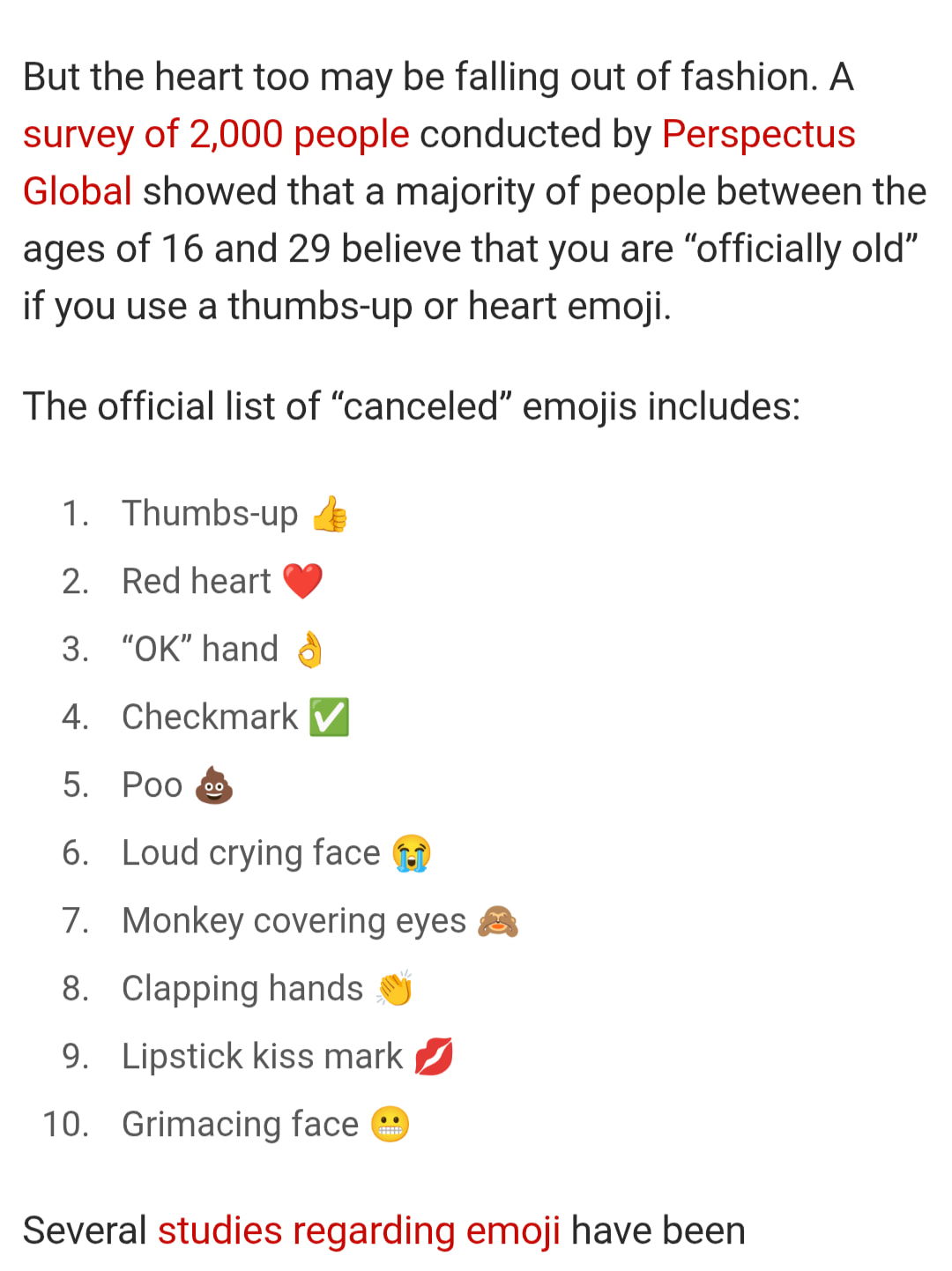
**And No, I do not like the NY Post. The others I found went to FB etc. Some from Forbes I think etc. this one had a list.

The best part of growing older is this: I don’t care what young folks think (or most people in general). It’s so freeing.

Nice and informative. I have also heard the thumbs up, emoji or not, is an insulting gesture in certain cultures, something people who work with foreign visitors are taught.

My question is what is the real distinction between thumbs up and the heart? And does Zazzle consider these things in ranking?

I am not always up on such things as emoji meanings and abbreviations. I used to play games online and ended up insulting people because I thought lol meant lots of luck. I quickly learned to restrict such things an emoji and abbreviation usage.

Bahaha!! OMG re the lol (I’m pretty sure I’m made fun of for too many lol’s too - can’t win) I mean lots of luck makes sense :rofl: I still have to look things up. I think it was well after SMH that I finally decided to figure out what it meant. I did see that about other cultures and the thumbs up. Ya know, once ya see it or it’s intentionally used like that on ya, ya can’t unsee it. I do see what they mean with that one sometimes. Not on here, though.

So, according to youngsters (people under 60), a thumbs up emoji is equivalent to the southern saying, “bless your heart.” (I think.)

I read somewhere once that some people (kids!) see the thumbs up as a middle finger … my kids know I’m old, I guess they will just have to live with how I use emojis! :rofl: (and this one literally says ROFL, so how can it be misinterpreted?)

LOL. I had no idea either!

Ha! I don’t give a rats patootie that these emojis have somehow been cancelled by the class of perpetually offended emotional buttercups. Knowing that they are now ‘out of favor’ makes me want to use them with reckless abandon in protest. Perhaps I’ll add a disclosure: “(and if you don’t like my choice of emoji, “middle finger emoji”). :+1:t2::poop::ok_hand:t2:

:rofl::zany_face::rofl:

Oh, trust me. With my kids I have gotten the “you can’t say that anymore” or “mom, do you know what that means now?” and honestly, they have a point with some things. And then I go into the “omg how many times have I said that? Does someone think I meant something else?” This emoji thing, though, idk. I brought it up, actually, because I thought if younger users saw the thumbs up, they might get the wrong idea. I guess it spun off a whole thing now ha! ayeeee

Yes, this exactly. Pretty much seen as a middle finger.

We’ve apparently entered an era where even punctuation needs emotional support. The thumbs up is now the middle finger, the heart emoji allegedly carries the oppressive weight of “unwanted affection,” and capital letters are considered aggressive unless used sparingly, like endangered wildlife. Nine more emojis were canceled for hurting someone’s feelings, right alongside Dr. Seuss, who’s still blinking in confusion from the cultural penalty box. At this rate, the next generation will file trauma reports over exclamation points too loud and ellipses…, which “imply judgment.” if cartoons, emojis, and basic grammar are all considered hostile, maybe the problem isn’t the symbols… maybe everyone’s just gotten a little too delicate .

I’ve had rounds of conversations with my kids and other “youngins” about this. I’m not so sure they’re necessarily delicate, but just more hyper-aware of emotions/psychology and see things that were done to us when we were growing up as abusive. And maybe they were. Well I’m certain they were in many cases. Which begs the question. Is it necessary to go through trauma to become a well-rounded “tough” human? I hope not. Idk. Still, I admit, they are hard for me to understand sometimes. I’ve definitely jumped to that conclusion before too. But I think they just have their own language and they stand up for others and the treatment of others. They are a unique bunch. And they have it so much worse than we did economically. The ratio of income to housing is insane. It’s a huge topic. There’s a movie called “Old Dads” out there. It’s funny to see what the generations above us thought of us too. Just the way it goes (or as my grandpa would say “the way the cookie crumbles.”

Edit: I didn’t mean that I’ve had conversations with my kids about emojis haha!! No, about how easily upset they have been at times about things that I would have brushed off. Which is where I understand where you’re coming from, because I have definitely been there. No, no. I’m pretty sure emojis are the least of the misunderstandings between our 2 generations. It’s a deep topic. They really are great “kids” though. And they’ll be the ones hopefully standing up for our rights and emotional health when we’re all super old (at least I hope). I’d rather have gen Z advocating for my elderly rights later in life than my own generation, I think. Ours might just say “broke your hip and your husband hit you? Buck up, deal with it and stop making him so mad.”

I get what you’re saying about younger generations being more hyper‑aware of emotions, but I don’t see our upbringing as abusive. Being told “if you fall down, you get back up” taught us how to overcome obstacles and not sweat the small stuff. It built resilience, not trauma. A lot of today’s sensitivity comes from growing up indoors with screens instead of real‑world bumps and challenges. When your world is digital, every tiny thing feels huge. That’s why they stand up for someone who got offended by an emoji they’re mortified over things we wouldn’t even notice. And I can’t even talk to my nieces and nephews without them getting upset. I was told to text them instead of speaking. That’s not emotional awareness that’s avoidance. Technology became the comfort zone and the shield from anything uncomfortable. Different worlds, different toughness levels. Their strength is emotional awareness; ours was resilience. The real balance is having both without turning every tiny bump into a crisis.

I’m not so sure it’s all about technology. As far as social anxiety goes (for example), I think there were many in previous generations who had that but were just labeled “quite or shy.” There is something to - oh what is it called? - immersion/immersive therapy or something? Which is what someone with “shyness” would have had to unintentionally go through back in the day because they wouldn’t have had therapy (as it was looked on as something only extremely troubled people went to) or meds. Maybe it was better. Maybe not. You’re right, though. Each generation has it’s own strengths and weaknesses. I suspect they probably acknowledge this more than we do. Or they just look at each other and say “ok boomer” and quote a Sponge Bob episode (I’m proud to say I speak fluent Sponge Bob - it was always on in the background when they were young)

Oh! Speaking of phones, you reminded me of something I’ve thought about with all of this too. I mean, ya know, we only had landlines that the whole house shared (with extra long cords if we were lucky). I think I got my own phone in my room when I was 15-ish. It was awesome (but a shared line, of course) Cold calling someone was normal. And we still see it as normal. But really, if ya think about it, it is intrusive now when we have cell phones. It’s like saying “I have decided that we will talk and we will do it now because it’s a good time for me” - or just popping over to someone’s house and knocking on the door out of the blue. But if you really think about it and look beyond the fact that it was normal when we grew up, it is kind of demanding. I don’t necessarily abide by that, because I still “cold call” ha! idk. Yah, it’s a pretty deep subject. I’m soooo tired today and am rambling. Great topic, though! : )

I guess that’s where you and I see it a little differently. I don’t really find cold calls intrusive at all probably because of where I live. Small‑town rural life is still very much “stop by, knock on the door, bring a tin of cookies” energy. My neighbors wave when they drive by, people still show up unannounced, and honestly… I like it. It keeps me connected to real humans instead of just living inside my phone. And that’s actually why I don’t buy the idea that calling is intrusive now. If it were, parents wouldn’t be buying dumb phones for their kids. I did a whole study on them, and the kids love them. They like talking, they like the simplicity, and they like feeling grown‑up enough to handle a real conversation. Parents want their kids to learn how to speak confidently not just text emojis and that says a lot. To me, calling someone isn’t “demanding,” it’s just being neighborly. It’s the same as knocking on a door or waving from the porch. Sure, texting is convenient, but I’m old‑fashioned enough to prefer being in the same space with real people. I like the warmth of it. I like the connection. And I like that my community still values that.

I wonder did this all start because one TikTok kid didn’t understand what a human hand looks like. One confused teenager points at a thumbs up emoji and goes, “Ah yes, the secret middle finger in disguise,” and suddenly the whole internet is playing follow the leader like it’s a biological conspiracy theory. It’s like a domino effect of digital anatomy failure. Did they all text each other like, “Hey guys, breaking news the thumb is actually the angry finger now”? Meanwhile the rest of us are over here thinking, “It’s literally a thumb. A thumb. The thing that helps you hold a sandwich.” If someone is mistaking basic human anatomy for aggression, that’s not emoji etiquette that’s a whole different conversation.