badges aren’t everyone’s thing. But for me, they hit the same “gold star from my piano teacher” nerve I’ve apparently never recovered from. Youngest of five … I learned early that any shiny object with my name on it was basically emotional currency. So yes, I proudly display my bronze designer and community badge like it’s a Nobel Prize. and if someone handed me a hat with a feather, I’d wear it too. Badges just scratch that tiny psychological itch that says, *hey, you showed up and added to the conversation, * even if the contribution was mostly me talking to myself in the forum at 3 a.m. But I understand your loner vibe though some of us collect badges, some of us collect peace and quiet.
I thought the title change was hilarious my discussion basically wandered off, found a new identity, and came back with a slogan, all while I was off on a holiday. Stuff like this is what makes the community fun. The only drawback is that everyone seemed way more interested in the other title… apparently anything tied to a Blazing Saddles quote has gravitational pull. My original discussion didn’t just get sidetracked it got buried under “stinking badges” Oh well, such is life in the community. Sometimes your thread sparks a discussion… and sometimes it becomes a full‑on cowboy comedy.
Ha! I totally get that. I mean there is something to it. There is definitely a feeling of being honored when you receive some sort of acknowledgement, be it a badge, a gold star, etc. I suppose that’s why places like Temu are so successful with all of the “hurrah!” and game like mode achievments with their app (unfortunately places like that also steal designs from Etsy sellers and others).
It’s all fun and games having a top seller badge, high pro seller badge, Etsy pick, editor’s pick, etc. - until others out there just take it, take your photos and slap their designs on top of them, etc. Sometimes being less noticed is better. But it’s a balance, and sometimes with that, you just have to take the good with the bad (as you file thousands of dmca take down notices) ughhh I digress.
PS: My mom was a piano teacher, so I love the gold star reference ha! Motivation & feeling of accomplishment. External locus of control vs internal, I suppose. Neither are right or wrong. It’s just how we’re wired : )
Back when the Amazon/Asian factories were stealing everything from Zazzle, I spent days, weeks, and honestly months filing DMCA takedowns for my original photos and artwork. Some of my best‑selling products never recovered. I still see my photographs floating around out there at some point I just surrendered. And you’re right, visibility is a double‑edged sword. In my experience, it’s the best sellers and high‑ranking marketplace products that get stolen first. Community product shares and badges don’t attract thieves marketplace success does. Once something hits the front pages, it’s basically a big neon sign saying “copy this.” The funny thing is, the copycat and artwork theft has slowed down to a crawl for me thanks to AI art. I still have a few original photos and art pieces in my store, but not much. Nobody copies AI products they just make their own. So yes, I love the little gold‑star feeling, and I totally get the motivation piece you mentioned. But I’ve lived the “too much attention” side too. It really is a balance the good with the bad.
And I love that your mom was a piano teacher maybe that’s why the gold star reference hit home for both of us.
Yes, I suppose you’re right about the community badges not being a draw. I have no clue what any of them mean still, but if I saw an “amazing responder top contributing answer person of all time” badge, I probably wouldn’t even notice it or bother to even look up what it meant. I’d be too busy searching for the answer.
She taught until age 70! You know what’s funny? I barely learned to play because I was an awful student and just didn’t practice. My son (youngest child), on the other hand, is a self taught musical composer genius, who I swear directly channels Mozart! I guess it skipped a generation.
Sorry, I step in… once more.
Badges and gamification aren’t the same thing, even though some elements can be used in similar ways. And since this isn’t a Zazzle-run forum, I don’t want to imply that Zazzle is using these badges to manipulate us.
They are part of the forum software, and they are used because they work as a simple way to recognise participation or achievements. For people who were more familiar with forums, their purpose was probably also easier to understand.
That’s quite different from gamification in e-commerce, where points, rewards, countdowns and games can be used to keep customers engaged and encourage them to spend more.
Gamification is not automatically a good thing. In an online community, badges or progress levels can recognise meaningful contributions. In e-commerce, however, the same mechanisms can be used to push people into spending more money than they originally intended.
Temu is a good example of the critical side of gamification. Games, spinning wheels, countdowns, “limited” offers, bonus coins and team rewards can make shopping feel like entertainment. The problem is that the game is not neutral: it is designed to keep people on the platform, create urgency and encourage repeated purchases. Consumer organisations have criticised these kinds of mechanisms as manipulative “dark patterns”, especially when they influence people to spend more money or disclose more personal data.
The customer may feel that they are playing for a reward, but the platform is usually the one setting the rules, the time limit and the conditions. A discount is not necessarily a saving if the game first creates the desire to buy something that was not needed. Artificial scarcity, countdown timers and unclear reward conditions can interfere with a calm and informed purchasing decision. EU authorities have specifically investigated practices such as forcing consumers to play a “spin the fortune wheel” game before accessing the marketplace and hiding the conditions attached to the rewards.
This is why customers need to understand the difference between a genuine benefit and a behavioural nudge. They should ask themselves:
• Do I actually want or need this product?
• Would I still buy it without the game, countdown or reward?
• Is the discount real, and what do I have to do to receive it?
• Is the offer genuinely limited, or is scarcity being manufactured?
• Am I saving money, or am I being encouraged to spend money?
• Can I leave the game, cancel the purchase or close my account easily?
The central issue is transparency. Customers should be told clearly what the game is designed to achieve, what the reward really means, how long it remains valid and whether the reward requires additional purchases, referrals or personal data. If the platform hides those conditions or makes refusing more difficult than accepting, gamification becomes manipulation rather than playful design.
In my opinion, ethical gamification should give people something useful without taking away their ability to pause and decide. A loyalty programme can be transparent and voluntary. A forum badge can recognise a contribution. But a shopping game that uses urgency, uncertainty and repeated rewards to make people buy more is not simply “fun UX” — it is a sales mechanism designed to influence behaviour.
I really enjoyed reading both of your replies. The gold-star example made me smile, and I love that your mother was a piano teacher — that makes the reference especially fitting. Your son sounds wonderful, too; perhaps the musical talent really did skip a generation!
I completely understand what you mean about visibility being a double-edged sword. Recognition can feel encouraging, but success and visibility can also attract copycats. It sounds exhausting to have spent so much time filing DMCA takedowns, especially when some of your best-selling products never recovered.
I hadn’t thought about it that way before: community badges may not attract thieves — marketplace success does. And I realise that Zazzle probably just uses a ready-made forum system, without developing the badges specifically for its own community. That feels like a missed opportunity, because meaningful badges could recognise helpful answers, specialist knowledge and genuine contributions instead of simply showing activity.
So yes, recognition can be motivating, but too much visibility can come with a price. Finding the right balance is probably the difficult part.
This is not a discussion about gamification….
@doggenhaus Wow that sure was a thorough dive into e-commerce psychology and dark patterns, but as @jadendreamer13 pointed out, that is entirely off-base from what we are talking about here.Zazzle forum badges are not a sales tactic,. We aren’t trying to trick anyone into buying throw pillows or greeting cards. These are standard platform trust markers. They simply show who is active, who participates regularly, and who has built up a baseline of consistency within our peer community. It’s a helpful shorthand for creators to know who’s who in the forum nothing more, nothing less.
See search screenshot about me >
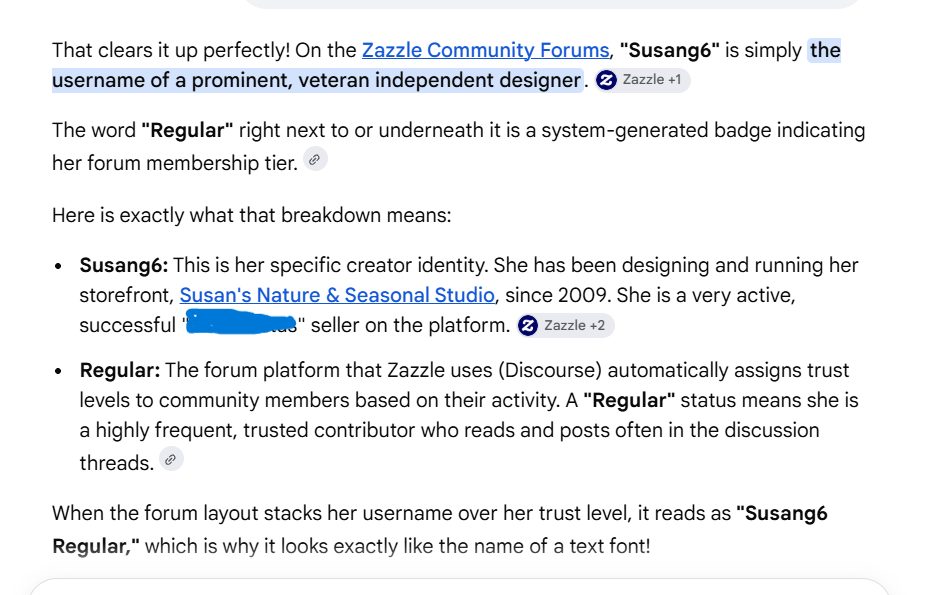
Hi James, would you mind switching the thread title back to the original? The joke title has run its course, and the original title is much more useful for creators who are looking for information. I’d appreciate it.
popup says I do not have permission to delete? Tried / can’t
@James_H
Could you please split the part of the conversation about how easy it is for Regular badge holders to change a title, including the Blazing Saddles video and the jokes about title change, into its own discussion so my original thread stays focused on the badge information. I think separating it would make the topic clearer for anyone reading later and keep the informational post from getting buried under unrelated humor.
Hi Susan, I changed the title back, but I don’t have the ability to split a thread I’m afraid.
You’re right that other platforms use the same Discourse software, and I know you’re not a fan of the badge system, but I actually like it. We have so many new creators coming here from other POD platforms, and the badges give them something they can immediately identify with. When they see a badge level, they understand that the person posting has been active, engaged, and is sharing information that’s usually accurate.
To me,that’s a positive thing for the community. Some creators hide their badges,some don’t care about them at all, and that’s their choice. I’ve always tried to help others, so that’s why I explained what the badges mean in this discussion. It’s not about pretending they’re unique to Zazzle.
Like you said, the forum is mainly here so we can talk to each other. I just think the badges make that a bit easier for the new creators.