Let’s Be Transparent: Creation Methods Belong in Your Storefront
- Mark as New
- Bookmark
- Subscribe
- Mute
- Subscribe to RSS Feed
- Permalink
- Report Inappropriate Content
11-10-2025 01:12 PM
Just a thought > If you’re selling designs, your About section should clearly state how those products are made. That includes photography, painting, digital editing, licensed artwork, or any other toolset. Customers deserve to know what they’re buying and creators should be upfront about their process.
I’ve noticed some recent pushback around how people create their products, especially when certain tools (AI) are involved. What’s frustrating is that the same voices asking for filters or disclaimers rarely explain how they make their own designs. That’s a double standard.
Stylus tools, Photoshop, and layer-based editing are treated as acceptable. But if someone uses a different toolset (AI), suddenly it’s flagged or questioned. Why? I don’t hide behind vague terms. If you’re using Photoshop, Procreate, or stylus-based digital tools, that’s digital art. If you’re using AI, that’s digital art. If you’re layering stock elements without attribution, that’s a conversation we should be having.
My store is built on clarity. I create every product myself from the photography and layout to the design and text. My About section spells it out. I don’t mass upload. I don’t outsource. I don’t hide my process. If we’re going to talk about transparency, it should apply to everyone. If you’re using templates, stock elements, or editing software, say so. If you’re building from scratch, great say that too. This isn’t about gatekeeping. It’s about being honest with customers and fair with each other.
Isn’t it fair to expect transparency from all creators whether they’re using original photography, painting, digital editing, licensed artwork, or AI tools?
- Mark as New
- Bookmark
- Subscribe
- Mute
- Subscribe to RSS Feed
- Permalink
- Report Inappropriate Content
11-10-2025 03:09 PM - edited 11-10-2025 03:10 PM
Unless a customer thinks they are buying an original, I don't think they care how the design was created, they care more about the quality of the product and if what they see is what they get
StyleArtc.com
- Mark as New
- Bookmark
- Subscribe
- Mute
- Subscribe to RSS Feed
- Permalink
- Report Inappropriate Content
11-10-2025 05:24 PM
There's a difference between your hands using an Apple Pencil and Procreate or Photoshop brushes to make a design, and telling a computer to generate pixels into a design (and yes, that is a form of outsourcing). Technically, AI generated images aren't "art" in the true definition of the word, because they are made by computer algorithms and not human creativity. That's the difference, not the medium used. If I paint a lighthouse, it doesn't matter whether the medium is acrylic paint, watercolor, gouache, or Procreate digital pixels. It's my hand making those brush strokes.
I do think there is a benefit for non-AI designers to market themselves that way, to stand out as truly creative and unique. There seems to be quite a bit of push back against the proliferation of AI generated images in the design world, especially when it comes to surface pattern design. And I know on Etsy and the various graphics sites, I appreciate when the creators point out that their artwork is hand painted, because these sites don't make it easy to filter out the AI stuff. But here on Zazzle, customers are more focused on the actual product and designs that catch their eye, and aren't particularly looking for handmade designs. And most people probably don't even read our about page, so they won't find that information if they are searching the marketplace.
- Mark as New
- Bookmark
- Subscribe
- Mute
- Subscribe to RSS Feed
- Permalink
- Report Inappropriate Content
11-12-2025 09:05 AM
I agree with everything you said and I want to add that one cannot transfer any physically created art (painted on paper etc) without some editing done via digital tool. My "about" part features the fact that I create hand drawn art but in the end I do not think that customers care about that aspect at all. They just want a nice looking product, regardless whether it was hand drawn on paper and scanned, digitally drawn or created by AI.
- Mark as New
- Bookmark
- Subscribe
- Mute
- Subscribe to RSS Feed
- Permalink
- Report Inappropriate Content
11-21-2025 08:44 AM
I mostly agree with you but I do sometimes get cute messages from customers saying they really like my art and to keep sharing my creativity. Which makes me feel that they appreciate the fact that I myself drew or painted the stuff! 🙂 Few and far between maybe but some people seem to care. I try to add a line that I am the artist to each product description too.
- Mark as New
- Bookmark
- Subscribe
- Mute
- Subscribe to RSS Feed
- Permalink
- Report Inappropriate Content
11-10-2025 05:57 PM
Since you’re calling me out specifically, I will respond to you directly. I am a professional artist with over 40 years of experience working for a variety of large-scale corporations. I create fine art using colored pencils, pastels, oil paint, watercolor, charcoal, copic markers, ink, gouache, and more.
I also have extensive experience creating computer graphics, corporate branding, logo design, marketing materials, presentations, and illustrations using Photoshop, Illustrator, InDesign, and all of the leading-edge design software.
I have worked in interior design, wedding design, and fashion design as well. I don’t need to call this out on my store. The quality of my work speaks for itself.
- Mark as New
- Bookmark
- Subscribe
- Mute
- Subscribe to RSS Feed
- Permalink
- Report Inappropriate Content
11-10-2025 07:37 PM
Amen!
- Mark as New
- Bookmark
- Subscribe
- Mute
- Subscribe to RSS Feed
- Permalink
- Report Inappropriate Content
11-10-2025 09:26 PM
In my opinion > If creators aren’t transparent about how they create their artwork, customers may assume it’s AI-generated. Transparency is not a threat. It’s a professional courtesy and a trust-building practice.
If you stop and think about it… AI art has flooded the market both online and offline. so its important to add how you create products at your about. to point out your expertise, your time and effort. Transparency protects your reputation. It also protects the customer’s trust.
- Mark as New
- Bookmark
- Subscribe
- Mute
- Subscribe to RSS Feed
- Permalink
- Report Inappropriate Content
11-11-2025 03:11 PM
Well that I agree with, stating your art is not AI can be a plus, especially when licensing your art to other designers. AI is very controversial, many people see it as fake images and copyright infringement, so designers who buy image licenses should know what they are buying, but the average customer buying a product does not care how it was made.
StyleArtc.com
- Mark as New
- Bookmark
- Subscribe
- Mute
- Subscribe to RSS Feed
- Permalink
- Report Inappropriate Content
11-11-2025 05:44 PM
That is a really impressive resume of experience & talent! 👍 You should call it out in your store. Because (and this is NO reflection on you personally or your specific artwork), it doesn't speak for itself anymore. If hand-done art spoke for itself there'd be no need to conspicuously label work that originated as AI creations as such. In the POD realm, I don't think most shoppers really care about the source as evidenced by the mass amounts of common stock images in use on popular themes. For those who do care, if they need a label to tell them this is AI and this isn't, then their buying decision is based on principle not aesthetics. For those shoppers whose buying habits are based on principle, then yeah, if one is a "hand-done" artist then they should absolutely be waving that flag in their product descriptions and About sections. Because you can't tell anymore and if you don't explicitly say how you created something, odds are it will be assumed to be AI.
Sure, there is a lot of stuff out there that is just AI slapped without care on products, sans any editing or personal attention to overall design. (Note - there are also lots of these slap-dash designs using imagery that isn't AI!) But there's also a lot of really good designs where the focal point is imagery that started with AI but the creator used their knack/talent for graphic design to make it into a pleasing overall design composition. Same as what happens with stock imagery. One didn't create the orig art but they created the overall design from it. And that's a skill in itself. Graphic Design is a talent in itself. One can be GREAT at creating art but stink at graphic design and vice versa, one can have no natural talent for creating hand-done art but be aces at graphic design. But there's never been an outcry to make it mandatory to label stock imagery when that's used in a design. So why is the use of imagery that began with AI singled out as something that needs a special disclaimer?
One hop around top search results highlights this. Many top-selling designs were created with stock imagery that was edited (or not) and artfully arranged with typography to make a pleasing overall design that won customers over. You can search popular themes and see dozens of designs by different designers that are all very similar but each employ their own unique take on the overall graphic design. So again I ask - why is this seen as different from designs that incorporate imagery that started out as an AI creation? Either the Designer hand-created the included imagery or they didn't. If they didn't hand-draw the imagery why does it matter if the orig source was stock, public domain or AI? And further, in the case of AI, the designer was intentionally working with and manipulating prompts to create their vision, they didn't just grab a ready-made graphic from somewhere. So technically, that should place AI generated work as more esteemed then designs incorporating stock or public domain ...
Also, may be interesting to know that there are "generativecontent" designs that are Editors Picks, and there's at least one product on the main Shop page that I am sure is AI generated imagery. So Zazzle doesn't care about the source of the imagery, either. They care about what they think will attract buyers.
There is a lot of talk about how AI renders don't have the "heart" of human hand-made stuff, that the fine brush strokes and mastery of lighting technique etc aren't there in AI. I don't disagree with that. But in the realm of POD, how much does that really matter? One is converting a hand-made work into a digital pixelated format which is uploaded and converted again before finally turning out as a printed design on a physical product. One is not buying an original canvas where such fine details can be admired.
I understand the fears & concerns & distaste natural artists have of AI. But in the POD realm, or other commericial applications, most of those arguments begin to crumble. Because if hand-done work is inherently superior to AI work, then why would AI work need its own label declaring it as such? Wouldn't everyone be able to tell without it? And that brings me back to my opening point. Rather than a mandatory label on things as stock, AI, public domain .... why not let the imagery speak for itself and if the creator thinks that it being hand-done is a selling point, then it's up to them to make that clear and use it as a marketing angle.
 |  |  |  |  |  |  |  |  |  |  |
- Mark as New
- Bookmark
- Subscribe
- Mute
- Subscribe to RSS Feed
- Permalink
- Report Inappropriate Content
11-11-2025 09:41 AM
I know very well what you mean, and I completely agree with you on some points. However, you can't impose your own standards on others. The artistic process is much larger and takes far longer than can be described in a text. Many artworks created analogously almost always require digital post-processing. Furthermore, one doesn't create art explicitly and exclusively for Zazzle products, especially since not all artworks are suitable for that purpose.
Anyone can sell products here. It's not necessary to create original designs. The licenses for digital products stipulate that the creator doesn't have to be credited. If you do it anyway, it's out of fairness.
Regarding AI: AI is not art! Not everyone can tell if graphics are AI-generated unless they created them themselves. An eye that isn't trained in some form of graphic/arts won't recognize it. AI always makes mistakes, and these mistakes aren't immediately obvious. That's why there are so many flawed graphics on Zazzle now, because they don't see them and most likely wouldn't be able to fix them. Which I find very alarming.
And yes, buyers want products that look good, with perfect printing that meets their expectations. I don't think they're going to read a text explaining how the design came about. What's is relevant is the size and the material of the products. That's what buyers look for.
- Mark as New
- Bookmark
- Subscribe
- Mute
- Subscribe to RSS Feed
- Permalink
- Report Inappropriate Content
11-11-2025 11:26 AM - edited 11-11-2025 12:04 PM
What defines art? Many say AI tools is not art. They say adding a prompt does not create art. I do not use prompts when creating AI art. I use sentences to explain my vision in detail, addressing the lighting the shadows, the clarity the resolution, the layout, collage, embossed or other describing exactly what I want in detail so that the tool understands my vision... I am leading the AI tools.
Isn't technical a form of art? You said “AI is not perfect, that there are always imperfections” ...wondering what form of art is perfect? I painted with oil and acrylic for decades, and there were always imperfections. I was critical of my art. Others loved it but I could see the brush strokes that were not right.
Clearly, I think differently than you. “I was taught that Art as intentional sensory experience (Issa): Created to interpret the world and evoke reflection.” My work with AI tools aligns with intentional sensory experience I do not input prompts; I am crafting a vision with technical precision and depth. So, when the Ai tool is led by the human vision, AI becomes a tool of artistic expression. (Oh and the first words in my statement "Just a thought" meaning in my opinion..I am not "imposing my standards on others" .
- Mark as New
- Bookmark
- Subscribe
- Mute
- Subscribe to RSS Feed
- Permalink
- Report Inappropriate Content
11-11-2025 06:09 PM
You've explained several times now, also in other posts, what impressions AI gives you. You may well be very convinced of what you're doing. One should always be. But it's still not art. In the truest sense of the word. But I'm just giving my opinion here. I'm only speaking for myself. However, I can agree with others. There's much more to art than just the vision. A work of art is never truly finished. An AI, on the other hand, just creates something new again and again, millions of times.
I'm not at all denying you the right to pursue your vision. If you develop something beautiful and sensual from it, I'm happy for you.
But the point here was that you believe designers should describe how or from what the respective work was created. And I believe that should still be left to each individual.
There There was a post in this forum from 2023 that also dealt with AI and how artists should deal with it. But it has a certain taste. Because the site advertised at the end of the post itself contains AI-generated graphics for sale, which you've already seen a thousand times on other content sites. In the end, individuality suffers because everyone is selling the same stuff.
- Mark as New
- Bookmark
- Subscribe
- Mute
- Subscribe to RSS Feed
- Permalink
- Report Inappropriate Content
11-11-2025 08:00 PM
Your comment feels like gatekeeping dressed up as opinion. Saying “it’s still not art” isn’t just your personal view it’s a refusal to acknowledge that art evolves. This isn’t about what you or I think AI is or isn’t. It’s about what the customer responds to. Art has always been in the eye of the beholder. You’ve taken a stand, and it’s rooted in resistance to change. If traditional art forms are your comfort zone, that’s fine. But don’t let that blind you to the fact that technical precision and digital mediums can absolutely evoke intentional sensory experience. I’m not here to argue definitions. I’m here to create, to lead the tool, and to evolve with the times. You can stay where you are. I’m moving forward.
- Mark as New
- Bookmark
- Subscribe
- Mute
- Subscribe to RSS Feed
- Permalink
- Report Inappropriate Content
11-11-2025 08:48 PM - edited 11-11-2025 09:43 PM
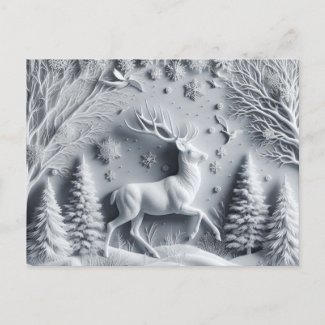
Is this art?
- Mark as New
- Bookmark
- Subscribe
- Mute
- Subscribe to RSS Feed
- Permalink
- Report Inappropriate Content
11-11-2025 10:05 PM
If you ask me like that, no! What is it supposed to represent? What are those crippled birds doing in the picture? It's creepy in a way. AI has absolutely nothing to do with the advancement of art. How did you come to that conclusion? I've also looked at some of your content. It all looks the same; you see it a thousand times over elsewhere. And it contains errors that an artist would never draw or paint like that. Even a sculptor doesn't just start working without a plan; they make a drawing and wouldn't dream of including such oddities. But I can see we can't convince each other. That's okay, though.
- Mark as New
- Bookmark
- Subscribe
- Mute
- Subscribe to RSS Feed
- Permalink
- Report Inappropriate Content
11-12-2025 01:45 AM
There are no birds in the image. It’s a winter-themed paper sculpture featuring a deer, stylized trees, and snowflakes. If you’re seeing birds, that’s a misinterpretation of the layered shapes.
Your comment about “errors an artist would never make” is vague. If you’re referring to specific visual elements, you’ll need to name them. Otherwise, it’s just a general dismissal.
You’re free to dislike the image. That doesn’t make it invalid. I posted it to ask whether it’s art, not to seek agreement.
- Mark as New
- Bookmark
- Subscribe
- Mute
- Subscribe to RSS Feed
- Permalink
- Report Inappropriate Content
11-12-2025 06:27 AM
****hopefully constructive criticism, I don't mean this to come off as rude-
It's actually really interesting that you don't see the birds. There are two and they look AI errors to me as well. The customer may not see them either, who knows. They may buy this at first glance because it's wintry and pretty and fits their style with the faith that the designer has created a good product, AI generated or not. Maybe they're happy with the result, but also maybe they send out 100 of these as Christmas cards and the recipients do spot the AI birds and cringe a bit. It's ultimately up to you if you care about that or not.
- Mark as New
- Bookmark
- Subscribe
- Mute
- Subscribe to RSS Feed
- Permalink
- Report Inappropriate Content
11-12-2025 12:16 PM
I didn’t initially read those shapes as birds, but I do see how they could be interpreted that way. To me, they function as abstracted accents part of the visual , not literal wildlife. That said, I agree it’s worth considering how different eyes might receive them, especially in a product context
- Mark as New
- Bookmark
- Subscribe
- Mute
- Subscribe to RSS Feed
- Permalink
- Report Inappropriate Content
11-12-2025 04:17 PM
I think the problem with those "birds" being interpreted as just abstract forms that represent motion, is that this piece is not an abstract piece. Every other element in this work is rooted in realism even if it is not a photo realistic piece. When you throw just one supposedly abstract element in there it is not likely to actually be read in an abstract way. Those random bits stick out and do not play with the rest of it. Most people will not understand what they are supposed to be and their minds will not wander to abstract thoughts in an otherwise "realistic" piece. They not only scream ai, I feel like they ruin an otherwise nice piece. (real paper sculpture is amazing by the way and is a labor of love)
 |  |  |  |  |  |
- Mark as New
- Bookmark
- Subscribe
- Mute
- Subscribe to RSS Feed
- Permalink
- Report Inappropriate Content
11-13-2025 12:23 AM - edited 11-13-2025 12:25 AM
I didn’t shape those winged forms directly they were part of what DALL·E 3 offered in response to my sentence-led composition. I didn’t initially notice them, and when I did, they blended into the overall composition.
To me, it was art. I’ve visited enough museums to know that art is in the eye of the beholder. I don’t dissect every element under a magnifying glass I evaluate the whole. If it feels right, I share it.
I hear that you feel strongly about this, but I’d like to clarify something: I’m not asking for validation. I’m sharing a piece that reflects my process,. I don’t expect everyone to agree with my choices, but I do expect a baseline of respect when discussing art especially when the critique shifts from the work to assumptions about the medium or the artist.
I’ve been transparent about my tools and process. If that’s not enough for you, that’s okay. But I stand by the integrity of the piece and the intent behind its creation.
I’m leaving this conversation because it’s no longer constructive. My time and energy are better spent creating, teaching, and writing with integrity. @
- Mark as New
- Bookmark
- Subscribe
- Mute
- Subscribe to RSS Feed
- Permalink
- Report Inappropriate Content
11-13-2025 12:08 PM
So, when I worked as an artist for large corporations, I would receive instructions on what graphic to create, the design style, the medium (or product), and what text and other elements were required. I’d then create a draft, and the work would be reviewed by a group. The group would provide feedback — sometimes positive and sometimes negative — and request revisions. Sometimes, I disagreed with their suggestions, but I completed the work as instructed. Other times, I agreed with their suggestions, and the end result was an improved product, and I learned something as a result of their feedback.
In this case, a group of your peers (whether you asked for the reviews or not) mostly seem to agree that the winged creatures are confusing and they are detracting from your design.
Why not bite the bullet and make the change? If folks here are confused about the winged creatures, your customers will likely have the same reaction.
The goal is to sell the piece to the most customers possible. So, whether the feedback was wanted or not, it is valuable feedback that you might want to consider.
- Mark as New
- Bookmark
- Subscribe
- Mute
- Subscribe to RSS Feed
- Permalink
- Report Inappropriate Content
11-13-2025 03:32 PM
The OP didn't ask for a critique or review of her work, she posted the design to show that AI generates "art". The only reason people honed in on the "birds" is because they were looking for a flaw in the generated output. The "birds" aren't noticeable nor detract from the pretty design and very unlikely would a customer be put off by it.
StyleArtc.com
- Mark as New
- Bookmark
- Subscribe
- Mute
- Subscribe to RSS Feed
- Permalink
- Report Inappropriate Content
11-13-2025 06:34 PM
Thank you for seeing the intent behind the post. I wasn’t asking for design feedback I was showing how the tool responds to structured input. The winged elements weren’t the point, but they became the target. Thank you for cutting through the noise and naming what was actually happening.
- Mark as New
- Bookmark
- Subscribe
- Mute
- Subscribe to RSS Feed
- Permalink
- Report Inappropriate Content
11-14-2025 05:46 AM
I wasn't "looking for a flaw" as you suggest. The winged elements stood out to me because they stand out. They don't fit with the rest of the elements in the image. Every other element (trees, snowflakes, deer, etc. looks more or less realistic, and then there's 2 weird winged things that don't make sense. Yes of course this is just one person's perspective but clearly, many people saw the same thing.
- Mark as New
- Bookmark
- Subscribe
- Mute
- Subscribe to RSS Feed
- Permalink
- Report Inappropriate Content
11-14-2025 06:26 PM
They don’t stand out unless you’re enlarging the image. Let’s be honest you were determined to find fault. The sculpture was visually balanced and seasonally styled, but you’re too caught up in your disdain for the medium to admit that.
The winged forms are subtle and abstract. They’re not meant to mimic realism they’re part of a layered collage meant to evoke motion and atmosphere. If you see something “weird,” that’s your interpretation. But calling them “errors” because they don’t fit your expectations isn’t critique it’s projection. I shared the piece to show what the tool is capable of not to be dissected by people who’ve already decided AI can’t produce anything of value. The winged forms weren’t the issue until someone decided they had to be. Suddenly, they became the proof that AI is flawed, that the tool can’t be trusted, that the artist must have missed something. That’s not feedback. That’s a search for fault to validate a bias. When the goal "of the group" becomes proving the medium is broken, the critique stops being about art and starts being about control.
- Mark as New
- Bookmark
- Subscribe
- Mute
- Subscribe to RSS Feed
- Permalink
- Report Inappropriate Content
11-15-2025 07:22 AM
When you shared your piece with the question, “Is this art,” you asked for feedback, Susan. That opened up the floor to answer your question. It was a subjective question that prompted a variety of subjective responses.
If you didn’t want feedback on your design, then you shouldn’t have asked the question, “Is this art?”
Once you ask a question like this, you can’t control the responses.
The responses you received are a consequence of your actions (in this case, the question you asked). And, now, since you don’t like the answers you received, you are complaining about them and the people who answered your question.
In my case, you said “I’m not a nice person,” yet I did not critique your piece or offer any feedback on it. Not once.
Yes, there is a problem here, but it is a problem of your own making,
- Mark as New
- Bookmark
- Subscribe
- Mute
- Subscribe to RSS Feed
- Permalink
- Report Inappropriate Content
11-13-2025 06:44 PM
I understand that your experience was shaped by corporate design teams, but that’s not the framework I work within. I’m not executing someone else’s brief I’m building structured, symbolic work through a calibrated process. That’s technical art, not mass-market design.
This wasn’t a request for critique. It was a demonstration of how AI responds to layered instruction. The winged elements weren’t a flaw they were part of the build. And when people fixate on them, it reveals a discomfort with the medium, not a problem with the work.
I’ve taught design. I’ve led teams. I know how to take feedback. But I also know when feedback is about control, not clarity. And I don’t revise my process to satisfy group discomfort
- Mark as New
- Bookmark
- Subscribe
- Mute
- Subscribe to RSS Feed
- Permalink
- Report Inappropriate Content
11-14-2025 02:26 PM
You're making another really good point with this post.
So, essentially:
- you received a "prompt"
- you designed accordingly
- you received feedback and requests for revisions
- you revised accordingly
= a finished design was made.
If we use the same logic that says a person who uses AI to create content is an artist using a tool, it would make you the tool and the group the artist. Which obviously isn't true.
- Mark as New
- Bookmark
- Subscribe
- Mute
- Subscribe to RSS Feed
- Permalink
- Report Inappropriate Content
11-14-2025 06:10 PM
I shared the embossed collage to show what the AI tool was capable of not to invite a group teardown or to ask for permission. The question was simple: Is this art? But instead of a yes or no, I got misinterpretation, projection, and pressure to “bite the bullet” and conform.
You’re describing a corporate workflow executing a brief, revising by committee, and delivering what the group approves. That’s valid in a corporate setting. But I’m not working from a brief. I’m architecting a process. That’s a different role entirely.
The winged elements weren’t errors. They were symbolic. You may find them confusing, but confusion isn’t failure it’s interpretation. And interpretation is part of art.
I value critique when it engages with the work. But what happened here wasn’t critique it was consensus-driven pressure. I’m not here to flatten my process for group comfort. I don’t need to “bite the bullet.” I need to keep creating. And I will.
- Mark as New
- Bookmark
- Subscribe
- Mute
- Subscribe to RSS Feed
- Permalink
- Report Inappropriate Content
11-14-2025 06:01 PM
You say it’s constructive, but the tone doesn’t read that way. Suggesting that I “don’t see” the birds or “don’t care” about customer reactions isn’t critique it’s condescension. You’re not just pointing out visual elements; you’re speculating about how customers might feel embarrassed, as if that’s the inevitable outcome. That’s not helpful. That’s projection. I see the winged forms. They’re abstract, intentional, and part of a layered collage experiment. The piece isn’t built for realism it’s built for atmosphere and motion. Customers aren’t cringing. They’re responding to the tone, the texture, and the seasonal clarity. You don’t have to like the medium. But if you’re going to critique the work, do it with respect. Otherwise, it’s not feedback it’s dismissal wrapped in politeness.
- Mark as New
- Bookmark
- Subscribe
- Mute
- Subscribe to RSS Feed
- Permalink
- Report Inappropriate Content
11-17-2025 07:35 AM
Sorry you took it that way, Susan. I was responding to your earlier comment where you said "There are no birds in the image. If you’re seeing birds, that’s a misinterpretation of the layered shapes.". I now understand that you meant for them to be there, and you meant for them to look like that as an abstract element, not birds, in your atmospheric composition. At the time of my initial comment (which you did respond to days ago), you had not yet explained that. Sorry you felt you needed to come back to this. My feedback was purely to you not seeing the birds and how that should be considered in the customers journey, and why you might want to consider that others do see them as errors. No shade intended. The good news is that your product is getting a lot of views and may lead to some sales this holiday season!
- Mark as New
- Bookmark
- Subscribe
- Mute
- Subscribe to RSS Feed
- Permalink
- Report Inappropriate Content
11-12-2025 07:09 AM
It's a lovely image, Susan. I do see it as art.
I also see a couple of birds in the image that appear as AI errors. One above the deer antlers and another to the right and slightly above the deer head.
- Mark as New
- Bookmark
- Subscribe
- Mute
- Subscribe to RSS Feed
- Permalink
- Report Inappropriate Content
11-12-2025 12:14 PM
I see those as abstract elements meant to accent the image and add a sense of motion. They could be interpreted as birds, but to me they’re more like stylized forms that fall under artistic abstraction. I guess that’s why they say “art is in the eye of the beholder.
- Mark as New
- Bookmark
- Subscribe
- Mute
- Subscribe to RSS Feed
- Permalink
- Report Inappropriate Content
11-12-2025 07:41 AM
You see, that's exactly the problem. You didn't mention any birds in the prompts, but the AI added them anyway. And those are definitely supposed to be birds. The deer is also depicted incorrectly. It doesn't even have its front legs on the ground. And no matter how you rotate it, it lacks the necessary posture for its intended stance. The two fir trees at the bottom left and right look like pipe cleaners.
For example, your Vintage Watercolor Christmas Village with Reindeer Tissue Paper:
In the foreground, is that supposed to represent a stream or a section of road? It goes right through the Christmas tree. The deer don't leave any footprints. You must have entered a prompt that made sense to you, but that's what the AI did. It's sad and concerning that you don't see things like this.
On your banner, it's even clearer how the AI interprets things like snowflakes and pine needles.
And look at other AI results; it's all the same. Your "works" are no different from anyone else's.
No matter what commands you input, the AI interprets them. You simply wait for a result. That's not a creative process, no matter how often you try to convince yourself otherwise. The AI is just taking what it wants. That's the crucial difference between new technologies, like photography, which creative people have worked on, and soulless AI, where artists weren't asked if they wanted to participate. It was practically dumped at the artists' feet, and in the end, only corporations profit from it. Try to understand it at least a little.
And comparing AI to digital art is utterly presumptuous. Because AI uses our work—that's a fact. So please, stop accusing me of resisting progress. AI isn't progress. AI is a bowl where everything has been dumped together and it spits out junk the world doesn't need. And the worst part is, the AI learns from this junk. It's a bottomless pit.
Let's drop this now. I can't reach you anyway, and you'll never convince me otherwise. So we're just going in circles.
- Mark as New
- Bookmark
- Subscribe
- Mute
- Subscribe to RSS Feed
- Permalink
- Report Inappropriate Content
11-13-2025 09:12 PM - edited 11-13-2025 09:30 PM
You’re right I didn’t ask for birds.> I asked AI to Create a winter collage with clarity and resolution; the image is embossed textures styled in a nature and wildlife collage with a centered stag deer in motion. Change gray tone to bright white color. > That’s why the front legs are upright. They’re supposed to be that way.. the deer is in motion.
And what you call a stream is clearly a dimensional snow drift a framing element designed to anchor the foreground. It’s not water, and it’s not a mistake.
I wonder what I’d find if I put your mass-produced quick-create products under a microscope. Repetition? Template dependency? A lack of symbolic intent? Maybe. But I won’t go there because I’m not petty like that
Your comment doesn’t read as critique it reads as contempt. You’re not engaging with the process, you’re tearing it down. That’s not feedback. That’s hostility.
I use AI tools with precision, symbolic intent, and iterative refinement. You may not respect the medium, but that doesn’t give you license to dismiss the discipline behind it.
You’ve projected your frustration onto me, misread my work, and tried to invalidate a process you don’t understand. That’s not about art it’s about control.
I won’t absorb your bitterness. I won’t mirror your tone. And I won’t apologize for working with clarity and purpose. You don’t have to agree with my methods, but you don’t get to erase them.
- Mark as New
- Bookmark
- Subscribe
- Mute
- Subscribe to RSS Feed
- Permalink
- Report Inappropriate Content
11-14-2025 12:13 AM
The big difference is that I criticized the results of your AI images ( you asked whether they were art). You're being personal and, in a way, insulting towards me.
I have no reason to be frustrated. I'm simply trying to explain that AI uses the content from artists. And no matter what contortions you go to in order to tell the AI what kind of image to produce, the result you get is still up to the AI's interpretation. But if you then start interpreting what the AI has interpreted, then ultimately the AI is the "artist" and you're the tool.
Besides, I never said I was against AI. I merely described the feelings that AI's results evoke in me, that in the end everything looks the same. Actually, I'm more disappointed than convinced.
And what exactly are mass-produced quick-create products?
- Mark as New
- Bookmark
- Subscribe
- Mute
- Subscribe to RSS Feed
- Permalink
- Report Inappropriate Content
11-14-2025 05:54 PM
You keep insisting that I’m not doing anything that I just “wait for a result.” That tells me you haven’t actually engaged with the process I’m using. What I’m doing is experimental. My embossed collage work is new, and it’s not instant. There’s a lag between instruction and result because the tool is following a layered, sentence-led build. It’s not a slot machine it’s more like writing HTML. I’m not prompting for randomness. I’m orchestrating structure, texture, and symbolic form. But I don’t expect you to understand that. You’ve made it clear that your dislike of the medium blinds you to the process behind it. You’re not critiquing the work you’re rejecting the tool. That’s your prerogative. But it doesn’t give you license to misrepresent what I’m doing or reduce it to “junk.” You don’t have to like AI-assisted collage. But if you’re going to critique it, at least meet it on its own terms. Otherwise, you’re not talking about art. You’re just defending your discomfort.
- Mark as New
- Bookmark
- Subscribe
- Mute
- Subscribe to RSS Feed
- Permalink
- Report Inappropriate Content
11-15-2025 07:36 AM
“I wonder what I’d find if I put your mass-produced quick-create products under a microscope. Repetition? Template dependency? A lack of symbolic intent? Maybe. But I won’t go there because I’m not petty like that.”
Oh, but you went just went there, Susan, and since you added the word, “petty,” which was meant to insult the person that you responded to, readers will now decide who is being petty. The responses to that comment will be varied - and you probably won’t like them - and they will be a consequence of your action.
- Mark as New
- Bookmark
- Subscribe
- Mute
- Subscribe to RSS Feed
- Permalink
- Report Inappropriate Content
11-12-2025 01:58 PM - edited 11-12-2025 02:21 PM
@grafXthings wrote:I've also looked at some of your content. It all looks the same; you see it a thousand times over elsewhere.
Less than 10% of my 5000 products involve AI-assisted elements, and all of those are clearly labeled. The rest are built from my own photography, digital design, and original templates. I don’t use Quick Create or mass uploads. Every listing is manually created and formatted by me.
If you think my creations “all looks the same,” that’s your opinion. My customers value the consistency, and designs. Cohesion isn’t a flaw it’s a standard
Also >
As for your “crippled birds” comment that’s interpretation. The abstract winged forms in that design suggest motion . If they caught your attention, they served their purpose. Abstract elements are part of art, not errors.

